

Cross-functional fitness is a functional training system that combines elements of strength training, gymnastics and cardio into a single training process. Unlike traditional fitness programmes, the main focus here is not on isolated muscles, but on movement as a whole: how the body works in space, how it adapts to stress and how universal physical fitness develops.
In recent years, cross-functional fitness has become the choice of people with different goals: from those who simply want to improve their well-being to athletes striving for high functional endurance. The reason for its popularity lies not only in its intensity, but also in the philosophy behind the method.
The principles behind crossfunctional training
The basic ideas that form the foundation of crossfunctional fitness. These are what set it apart from traditional gym workouts.
1. Functional movements
CrossFit uses movements that mimic everyday activities: squats, lifts, jerks, weight transfers, jumps. These exercises engage several muscle groups at once and require coordination. The functional approach makes training practical – the body learns to work efficiently, not just look toned.
2. Constant variety
One of the key features of cross functional fitness is the absence of repetitive workouts. Programmes change regularly, which reduces the effect of habituation and maintains a high level of engagement. Variety also helps to develop different physical qualities: strength, speed, flexibility, balance, and endurance.
3. Relatively high intensity
The intensity is selected individually, but the format itself involves working with limited time and a clear structure. This allows you to get a pronounced training effect even with sessions lasting 45-60 minutes.
Intensity does not equal overload – correct technique and load adaptation are more important than speed of execution.
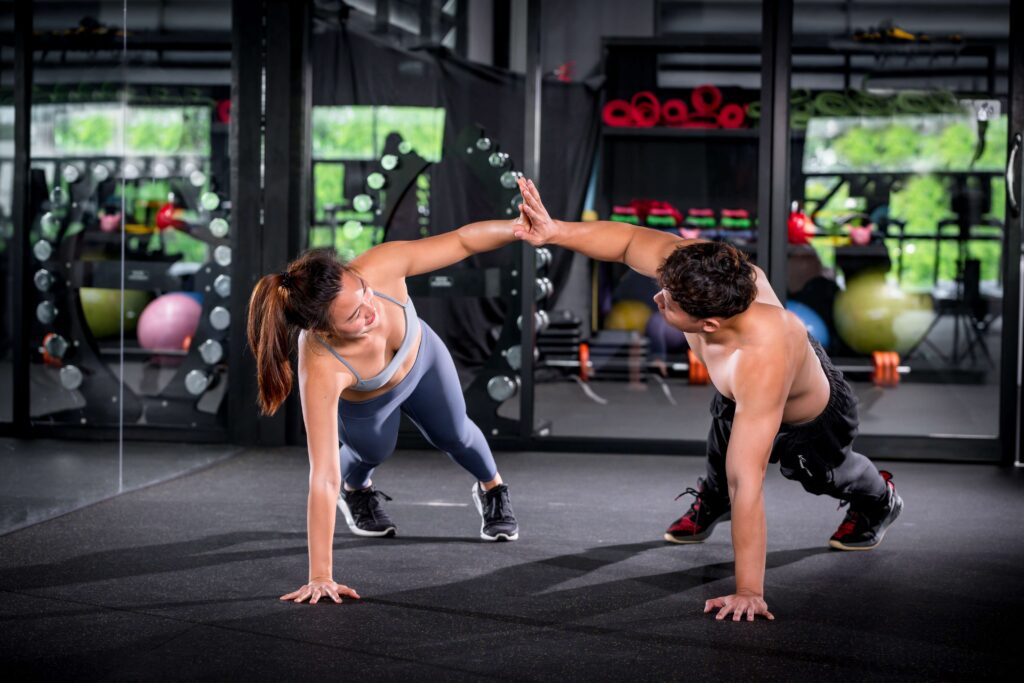
How a typical cross-functional fitness training is structured
To better understand the format of the classes, it is important to realise that CrossFit training is not a random set of exercises, but a logically structured process. Each session has a clear structure in which the load is distributed in such a way that the body gradually gets into the swing of things, safely performs intense elements, and then correctly comes out of a state of high activity.
A well-thought-out sequence of stages reduces the risk of injury and makes training effective regardless of the participant’s level of preparation. At the same time, the format remains flexible: the trainer can adapt the duration of individual blocks, change the emphasis or simplify movements while maintaining the overall concept of the session.
Main stages of training:
- Warm-up – prepares the joints, ligaments and nervous system for work, raises body temperature and activates the muscles that will be involved in the main part of the workout.
- Technical block – a stage at which a new movement is learned or the technique of already familiar exercises is practised. The emphasis here is on correct mechanics, body control and breathing.
- Main complex (WOD) – the central part of the workout, which is a combination of exercises performed according to a set pattern: for time, for number of repetitions or at intervals. It is in this block that the main training load is achieved.
- Cool down and recovery – the final stage, which includes stretching, breathing exercises and mobility work to help reduce muscle tension and speed up recovery.
After completing the workout, participants feel a comprehensive load on the entire body. This effect is due to the fact that cross-functional fitness involves the body as a single system. Over time, this contributes to improved overall coordination, endurance, and the ability to cope with physical tasks in everyday life.
What physical qualities does cross-functional training develop?
Cross-functional fitness is valued for its universal approach to physical development. Unlike highly specialised disciplines, cross-functional training does not focus on a single physical parameter, but rather develops comprehensive physical fitness. This format allows the body to adapt to different types of stress and cope more effectively with tasks both in a sporting environment and in everyday life.
Main areas of development:
- Strength – developed through bodyweight exercises, free weights and exercises that engage large muscle groups. This approach develops not only muscles but also joint stability.
- Endurance – developed through cyclical and interval training, which trains the body’s ability to work under conditions of increased heart rate and prolonged exertion.
- Coordination – improved through multi-joint movements that require precision, balance, and synchronised work of different parts of the body.
- Flexibility and mobility are developed through regular work with a range of motion, which has a positive effect on joint mobility and reduces the risk of injury.
- Reaction speed is developed through dynamic exercises and changing movements that require quick decision-making and control of the body in space.
The combination of these qualities makes Crossfunctional Fitness effective for improving physical appearance and increasing overall physical fitness. This type of training helps the body remain strong, stable and adaptable in the long term, which is especially valuable in an active and mobile lifestyle.
Crossfunctional Fitness and Weight Loss
Many people come to Crossfunctional Fitness with the goal of changing their body composition, not just seeing a number on the scales. Crossfunctional training affects several physiological processes related to fat burning and maintaining a healthy weight at once. Here, results are achieved through a combination of exercise, bodily adaptation, and lifestyle.
Unlike monotonous cardio workouts, crossfunctional training engages a large number of muscle groups simultaneously. This leads to increased energy consumption during the workout and maintains an elevated level of metabolic activity after it is completed. The body continues to expend energy even at rest, as it needs to repair muscles and the nervous system.
Intense workouts stimulate muscle growth and maintenance, and muscles play a key role in regulating metabolism. The higher the proportion of active muscle tissue, the more energy the body expends throughout the day, even without additional physical activity. Therefore, the changes achieved through cross-functional training are often more stable.
Crossfunctional fitness is not a ‘quick fix’ or short-term strategy. It does not provide instant results through extreme exercise, but works as a system when practised regularly. Gradual fat loss, improved tone and lasting changes in the body are the result of consistent work, not drastic restrictions.
Crossfunctional Fitness as a long-term health strategy
Crossfunctional fitness is a powerful tool for those seeking a comprehensive approach to physical fitness. Its effectiveness is based on functionality, variety, and adaptability. With a conscious approach and proper training organisation, crossfunctional fitness can become a sustainable part of a healthy lifestyle, rather than a temporary experiment.
In the long term, crossfunctional fitness can become not just a form of training, but a system for maintaining physical activity. It adapts to age, fitness level and changing goals. Regular training helps to maintain mobility, strength and confidence in one’s own abilities, which is especially important in a sedentary lifestyle.
Comments are closed